Liquidity Constraints and the Value of Insurance, joint with Justin Sydnor. American Economic Journal: Microeconomics 2026. PDF here.
Insurance for People Who Don’t Have Access to Credit
The workhorse model of health insurance demand assumes individuals care about how insurance affects the total risk they face in spending, but that they do not care about when the spending arises. You pay a premium, you face out-of-pocket expenses at the doctor or at the pharmacy, and the model treats a dollar of premiums and a dollar of out-of-pocket spending as having the same impact on your well-being. Everything inside the policy year washes out: when the premium is collected, when the bill is due, whether there is cash in your bank account to pay it.
That abstraction is defensible if people have access to assets or credit. Many do not. Many people hold limited liquid assets. These households care not just about how much they have had to pay over the year, but whether a $1,200 bill has to be paid in a single month or is spread across twelve.
Our paper asks how this distinction affects the value of insurance. The key modeling change is to let a contract span many consumption periods: a health or auto policy covers a year, while consumption happens month to month. We prove our results for an extreme case, the “cash-on-hand” individual who can neither borrow nor save, then relax that in calibrations allowing borrowing at costs up to subprime levels.
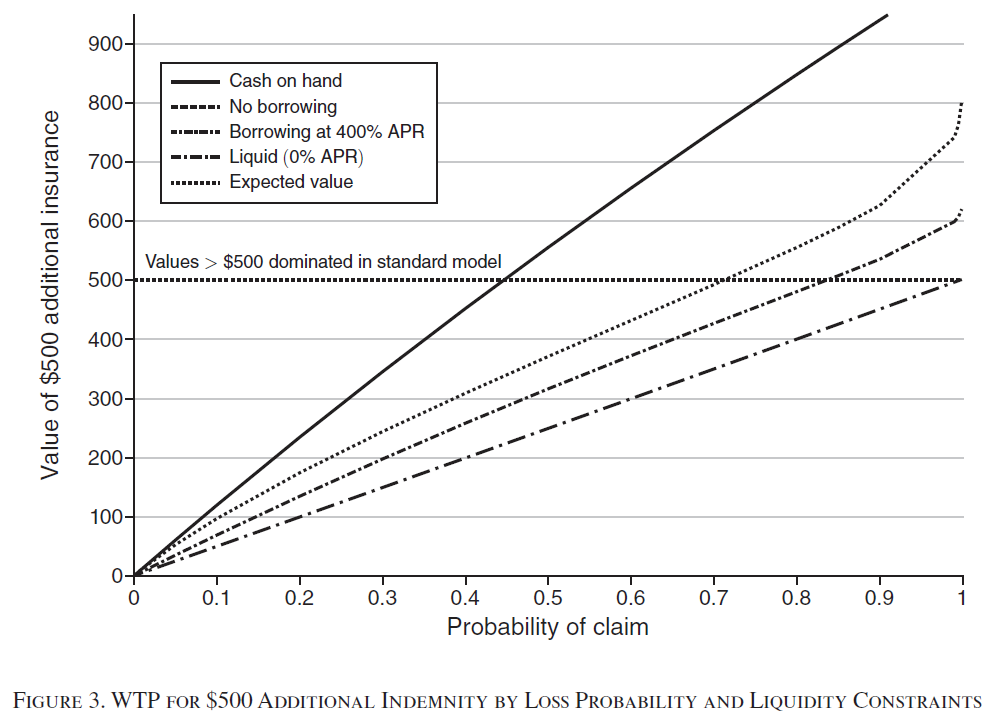
For someone who cannot smooth consumption on their own, insurance provides two benefits. The first is the standard risk-protection benefit: it transfers resources to states of the world in which need is higher. The new benefit we highlight is the financing benefit: insurance allows you to transfer resources across time, since a premium spread over twelve months substitutes for a bill that would arrive all at once. The standard model misses this financing benefit.
The financing benefit of insurance changes how we view decisions that have been assumed to be clearly mistakes. First, a constrained individual can rationally buy insurance priced at or above what it pays out. Such a purchase is dominated in annual wealth terms but not in consumption flows: the indemnity arrives in the month of the loss, when marginal utility is high, while the premium is financed out of months when it is low. Second, and for the same reason, a constrained individual can rationally insure a loss that is certain to occur, a case where the risk-transfer benefit is exactly zero.
Revisiting Foundational Insurance Claims and Anomalies
The financing benefit of insurance changes how we view decisions that have been assumed to be clearly mistakes. First, a constrained individual can rationally buy insurance priced at or above what it pays out. Such a purchase is dominated in annual wealth terms but not in consumption flows: the indemnity arrives in the month of the loss, when marginal utility is high, while the premium is financed out of months when it is low. Second, and for the same reason, a constrained individual can rationally insure a loss that is certain to occur, a case where the risk-transfer benefit is exactly zero.
Another classic result is Mossin’s theorem: a risk-averse person buys full coverage if and only if the price is actuarially fair. We find the theorem survives under liquidity constraints when premiums are paid smoothly through the year. It fails when the entire premium is due up front. The reason is that the premium schedule, not the loss, has become the shock. With upfront payment and full coverage, the first month’s consumption is lowest. Reducing coverage pulls money back into the month where it is scarcest. Liquidity constraints can lead individuals to underinsure at fair prices and appear risk loving. This is not merely theoretical. Casaburi and Willis (2018) find that take-up of crop insurance among Kenyan farmers is dramatically higher when the premium is collected at harvest, when cash is on hand, rather than all at once.
Liquidity constraints do not explain away the anomalies documented in insurance choice, as confusion is real and well established. But some behavior interpreted as error has a rational basis. Welfare judgments should account for this possibility, and separating the two is an empirical question worth taking up.
Designing cost sharing
The practical payoff is in contract design. Arrow showed that, absent moral hazard, the optimal partial-coverage contract is a straight deductible with full coverage above it because it minimizes your exposure to risk. We show that a liquidity-constrained individual can prefer a contract that exposes them to more total risk, but with smoother payment flows. For instance, a liquidity-constrained individual might prefer a lower deductible (to avoid the concentrated risk in one period) even though it would come with higher risk over the whole year.
We simulate the value of cost-sharing designs of identical actuarial value against monthly medical spending profiles constructed from commercial claims data: each covers the same fraction of medical expenses. For the perfectly liquid individual, Arrow’s result holds– the alternative contracts expose you to more risk– and the exact design has relatively low stakes: the worst design in the space we examine costs less than $5. For the cash-on-hand individual, not only do they prefer lower deductibles with more total risk, but the stakes are higher: the worst design hits them harder, with welfare losses over $100.
Two implications follow. Cost sharing for a liquidity-constrained population should look different. And nudging people toward standard benchmarks or taking away dominated plans may leave people facing too much risk.
Conclusion
For someone who cannot borrow, a premium dollar and an out-of-pocket dollar differ because one arrives smoothly and one arrives all at once. And contract features matter beyond the level and variance of spending, because they determine when spending translates into consumption.
This paper shows how liquidity constraints change how we interpret the value and design of insurance. To keep things tractable, this paper shut down moral hazard: the size and probability of losses were held fixed. In a companion paper, we examine how the interpretation of moral hazard changes in the presence of liquidity constraints.

