April 16, 2026
Healthcare affordability is a real and urgent challenge in Massachusetts. Families feel it in premiums and deductibles. Employers feel it in compensation costs. The state feels it in budget pressure.
But before we can treat the problem, we need a clear diagnosis. And a good diagnosis starts with a simple question: is healthcare actually growing faster than the economy as a whole? Does Massachusetts need to spend less on healthcare overall?
The data says no — and that surprised me.
What the Numbers Show
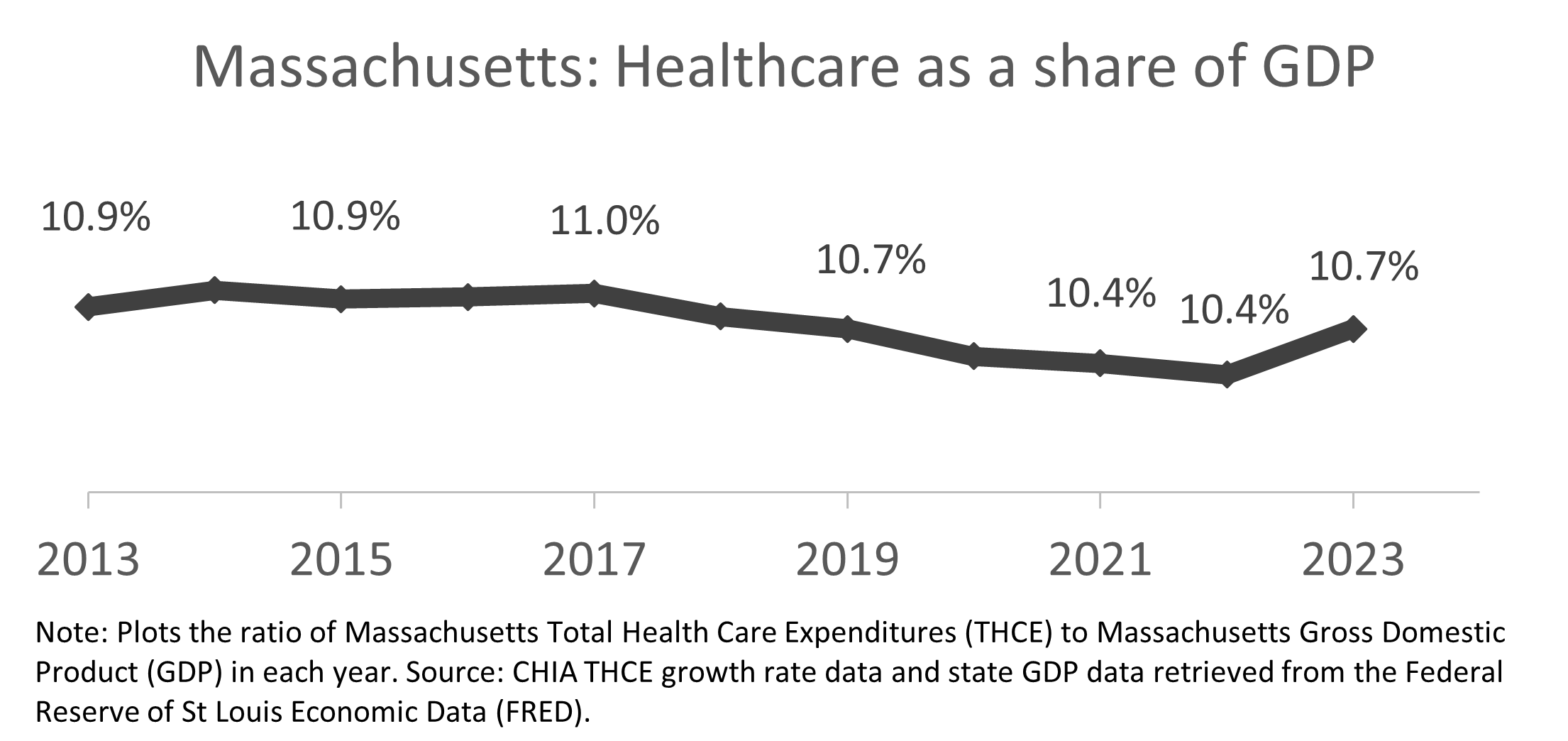
The picture above tells the story. Healthcare is a slightly smaller share of the Massachusetts economy in 2023 than it was a decade ago. In 2013, total health care expenditures were 10.9% of state GDP. In 2023, they were 10.7%.
Over the ten years that Massachusetts has been measuring spending against its cost-growth benchmark, the Commonwealth has succeeded in keeping healthcare costs from growing faster than the economy.
The same pattern holds when we look at spending relative to income. In 2013, it took 11.7% of the median household’s income to cover average per-person healthcare spending. By 2023, that was down to 10.5%.
Why This Matters
I keep hearing the phrase “unsustainable growth.” But the growth Massachusetts has actually experienced 2013-2023 is sustainable. It is not out of line with the growth of income in the Commonwealth.
Getting the diagnosis right matters because the treatment follows from it. If aggregate healthcare spending were persistently outpacing our ability to pay, the natural response would be to intensify the consequences for exceeding the benchmark, squeeze total spending, and accept that some care will be forgone along the way. That is not the situation we are in.
Affordability, however, remains a serious problem. The problem is not that spending in aggregate is outpacing our ability to pay. The problem is that particular parts of the system are not working well, and they are creating real hardship for particular families.
Consider three distinct affordability problems:
Premium spikes on the Connector. Some Massachusetts families saw their Connector premiums rise sharply this year because the enhanced federal subsidies were withdrawn, even though the Commonwealth stepped in with extra subsidies to shield many people. That is not mainly about the level of health spending — it is about how we finance it.
Painful deductibles. Many families face deductibles that are painful and difficult to meet when care is actually needed. That is not mainly about the level of spending either — it is about how costs are allocated, and when families are asked to bear them.
Prices from market power. Some providers charge prices that may be too high because of market power or anticompetitive conduct. That is a genuine affordability problem, and it calls for solutions targeted at those specific actors.
None of these problems are solved by pushing down aggregate spending growth. They are solved by targeted interventions: supporting low-income families, designing cost-sharing arrangements that do not discourage needed care, and using competition policy where prices reflect market power rather than value.

